










地域の潜在力の追求
Pursue Local Potentialities
吉野川流域剣山地域の高地集落
Highland settlements of Tsurugi Mountain range in the Yoshino River basin
新居照和・新居ヴァサンティ・メノン
Terukazu Nii and Vasanti Menon Nii
人と自然の豊かな関係の再構築に向けて
世界規模で,グリーンで低炭素の社会への移行が強く求められる中で、日本では2020年までにすべての新築建築物に低エネルギー基準が義務付けられることになった。その流れにおいて、各建築物の環境性能向上を図る一方で、それぞれの地域に伝わる伝統的な知恵や技術に基づいた地域生活環境やライフスタイルを、全国各地でどのように未来へと継承していくかが重要な課題となっている。
安定的で持続可能な低炭素社会を実現するためには、各地域の気候や、山、川、海をつなぐ循環型生態系に直接基づいた、包括的な環境デザインが極めて重要である。自立的で循環型の社会の基盤となるのは、周囲の自然環境と健全で豊かな関係を築き、自然システムを制御・搾取するのではなく、むしろ強化するような先進的な技術によって支えられるグリーンライフスタイルである。その確立は、災害への備えや社会のレジリエンス向上にもつながることになる。
吉野川の洪水との共生
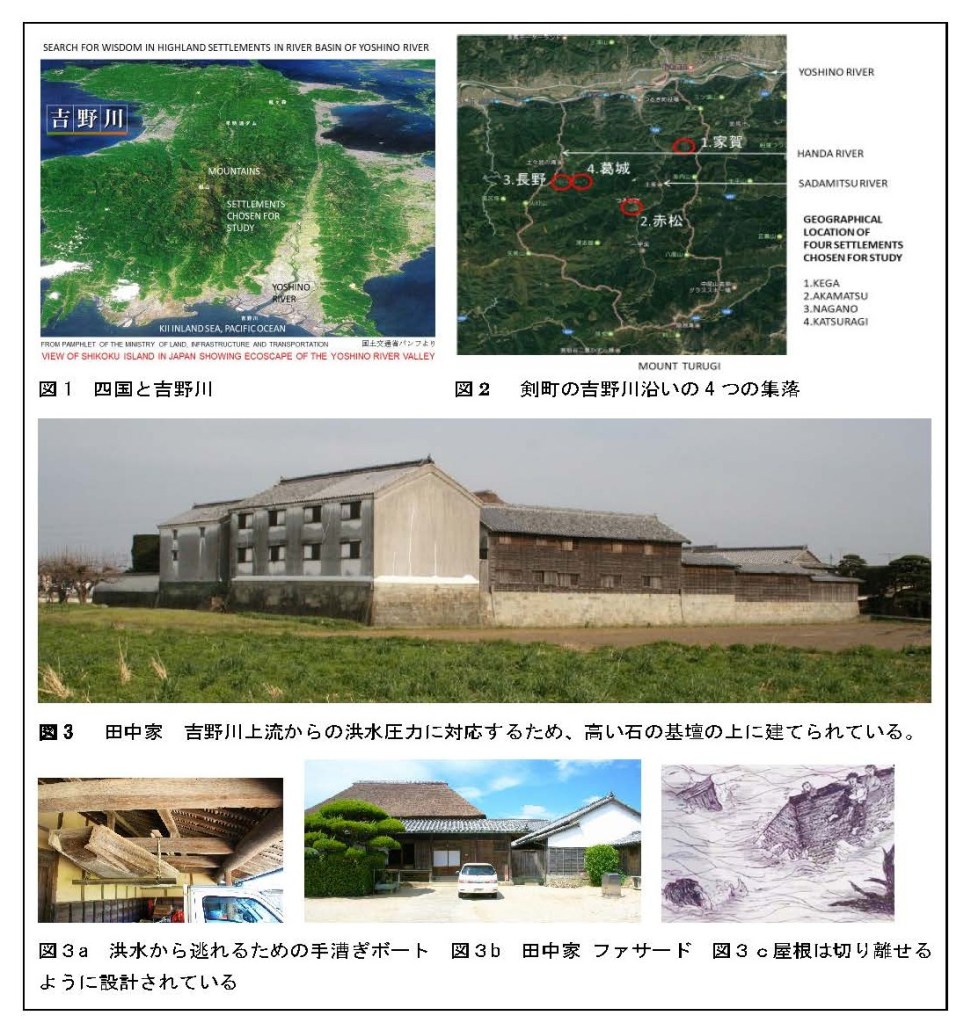
日本三大河川の一つに数えられる吉野川は、四国を東西に流れている。全長194km、流域面積3750平方kmを誇り、古くから洪水に見舞われてきた(図1)。山から海へと栄養分を運び、森林と田畑、河川と海洋の栄養分や魚類を繋ぐ大きな循環システムを形成している(図2)。この地域の藍畑は、吉野川の定期的な洪水によってもたらされる栄養分に頼ってきており,藍農家は川沿いに暮らし、耕作し、高い石造りの土台で囲まれた敷地内で染料を生産してきた。田中家(図3)には、手漕ぎボートが備え付けられている(図3a)。藁葺き屋根の中央の住居部分は、洪水時に住民が避難するための浮きとして、屋根の骨組みから切り離せるように設計されている(図3b、c)。こうして作られた染料は、河川や陸路で日本全国へと運ばれていたのである。
途切れることのない地球規模の物質循環
河川は、多様な役割を担う複雑な自然循環システムの一部である。吉野川の伝統的な治水システムは、河川の自然な物質循環メカニズムに影響を与えないシステムである。
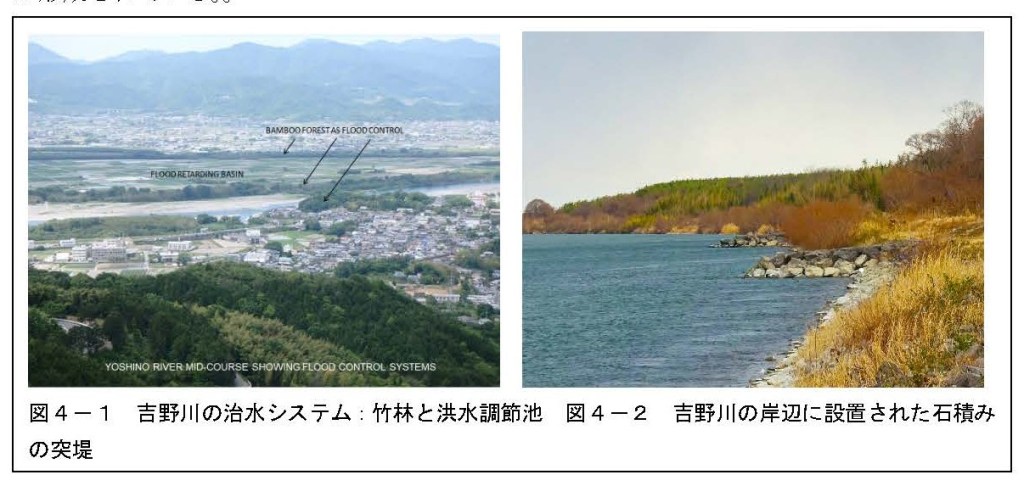
1. 吉野川沿いの竹林は、現在日本最大規模を誇るが,河岸沿いの竹林(図4-1)は、洪水時の水の勢いを弱めつつ、竹林が作り出す柔軟なスクリーンを通して栄養分を透過させるのである。
2. 堤防間の河川流域を広げて作られた堰堤(図4-1)は、一度に下流に流れる水量を減少させる。そして,平時には様々な野菜を栽培する農地として利用される。多様な動植物を育む生態系であり、漁業の生産性向上にも貢献している。
3. 河岸に垂直に一定間隔で設置された石積みの突堤(図4-2)は、水の流れを遮断し、河岸の侵食や堆積を防いでいる。
吉野川上流では、以下にみるように、複雑な自然システムが巧みに利用された建築環境が形成されている。。
「天空の故郷」ソラ――自然の多様性に富んだ斜面集落
剣山(つるぎ)は、標高1955mで西日本有数の高峰である。古くから多くの神話に彩られた宗教的な象徴でもある。徳島県西部、吉野川に流れ込む剣山の急斜面には、標高100mから900mにかけて約200の集落が点在している。これらの集落は、日本の主要4島のうち3島を貫く中央構造線の南側に位置している(図1、2)。
これらの集落は、土砂崩れの跡地に築かれ、災害によって露出した自然の水路を巧みに利用し、年間を通して安定した水源を確保してる。それぞれの集落は数百メートルの標高差に広がっている。
地表排水が良好なため、北向きの斜面は緩やかだが、南向きの斜面は岩盤が固く、急峻である。南向きの斜面は「日向(ひのじ)」、北向きの斜面は「陰(かげじ)」と呼ばれる。この緯度では、冬の低い日差しから暖かさを得られるため、南向きが有利とされている。しかし、ここでは優劣はなく、それぞれの地域の特性が最大限に活かされている。
深い谷には強い水平風が吹き込む(図5-1)。日中は強い垂直風が谷を吹き上がり、夜は山を下る(図5-1)。この風の流れと、気温や土壌層が異なる標高差が相まって、多様な微気候が生まれ、様々な動植物が生息する環境となっている。また、日中の気温の急激な変
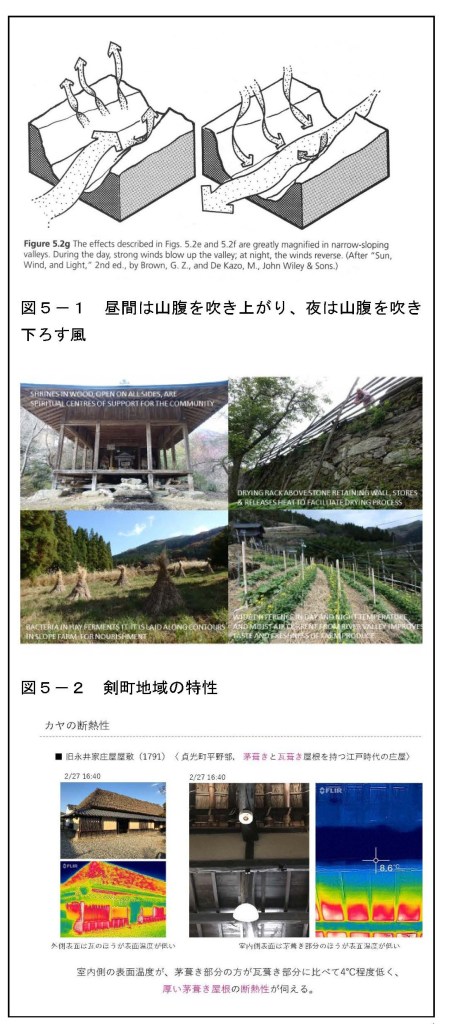
化は、農産物の品質と保存性を高める。標高の高い地域には、比較的平坦な土地と日照量が多いという利点を持つ古い家屋が多く見られる。
これらの集落に共通する特徴は以下のようである(図5-2)
1. 「オド」は、三方が開放された木造建築物である。共同体を支える祈りの場として機能し、主要な交通路沿いに点在している。ここでは共同の祈りの集会だけでなく、谷を挟んで住民同士が視線を交わすことも、意外なほど強い絆を生み出している。
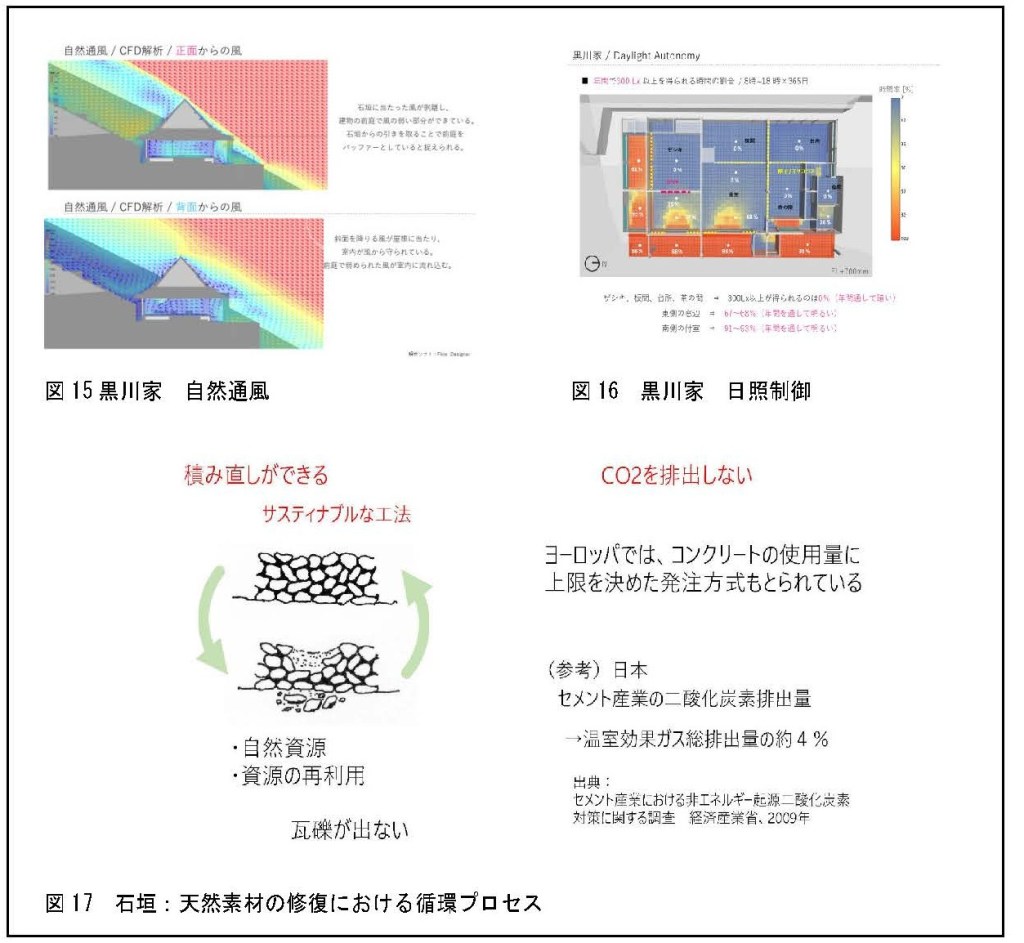
2. 「ハデ」は、農産物を乾燥させるための木造の枠組みである。日中は太陽の熱を蓄え、夜間は赤外線を放出する乾式石積みの擁壁の上に設置されていて,これにより、日差しと風による乾燥が促進され、高度な食料保存文化が育まれ、集落の自給自足が強化される。現在、老朽化が進んでいるが、石積みの維持管理を公共事業に組み込むことで、伝統的な技術を継承し、天然資源を活用し、セメントの使用を避けることができる(図17)。
3. 「コエグロ」は、斜面に沿って積み上げられた、地元産のカヤ草の干し草である。太陽、雨、風にさらされることで、干し草にバクテリアが繁殖する。この干し草は、土壌を肥沃にするために、傾斜地の等高線に沿って敷き詰められる。このシステムは、何世代にもわたって地域の生態系サイクルを維持してきたものである。さらに、世代を超えて受け継がれてきた種の種子が収集、保存、再利用され、長期間にわたって維持されてきた地域の持続可能な生態系サイクルが完成しているのである。カヤ草は屋根材として非常に高い断熱性を持っている。屋外では表面温度がタイルよりも高くなるが、屋内ではタイルよりも低くなる。(図5-3)
4. 特徴的な傾斜地(段々畑ではない)は、自然の等高線に沿って耕作される。傾斜地は平地よりも太陽からのエネルギーを多く受ける。そして、農民の手の届く高さまで傾斜している。ただ、このシステムは土壌を固定するために多くの労力を必要とし、土地の等高線に沿って発酵させた干し草を敷くことで、急斜面での土砂崩れを防いでいるが,傾斜が30度にも達する場所もある。この独特な持続可能な農業システムである「斜面耕作」は、2018年に世界農業遺産に登録されている。
神性と結びついた集落形態
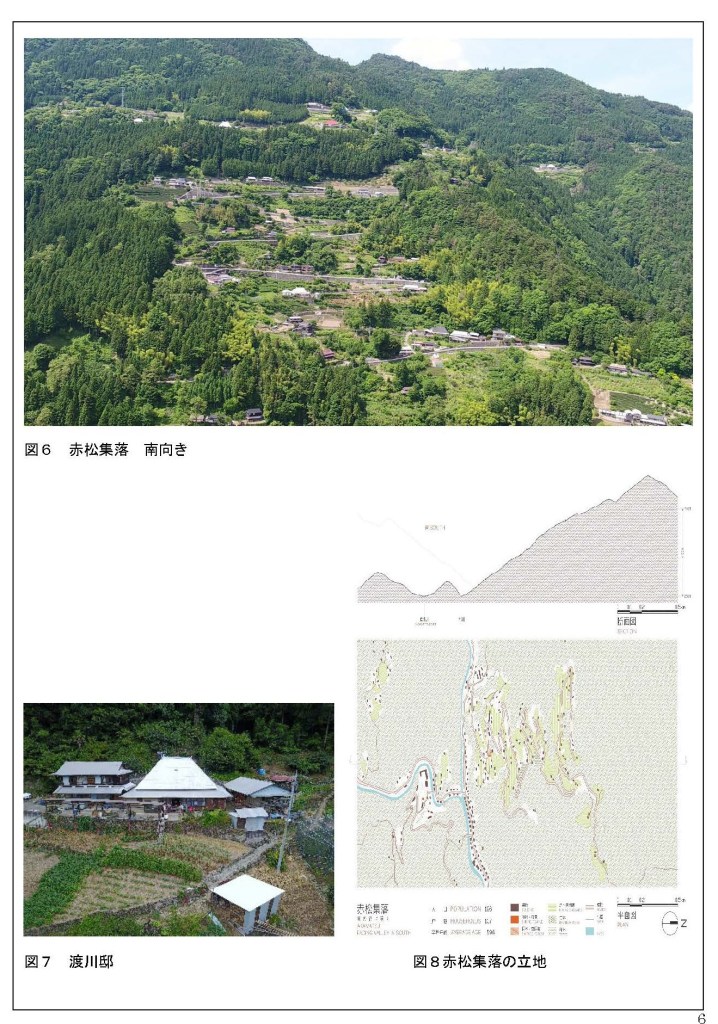
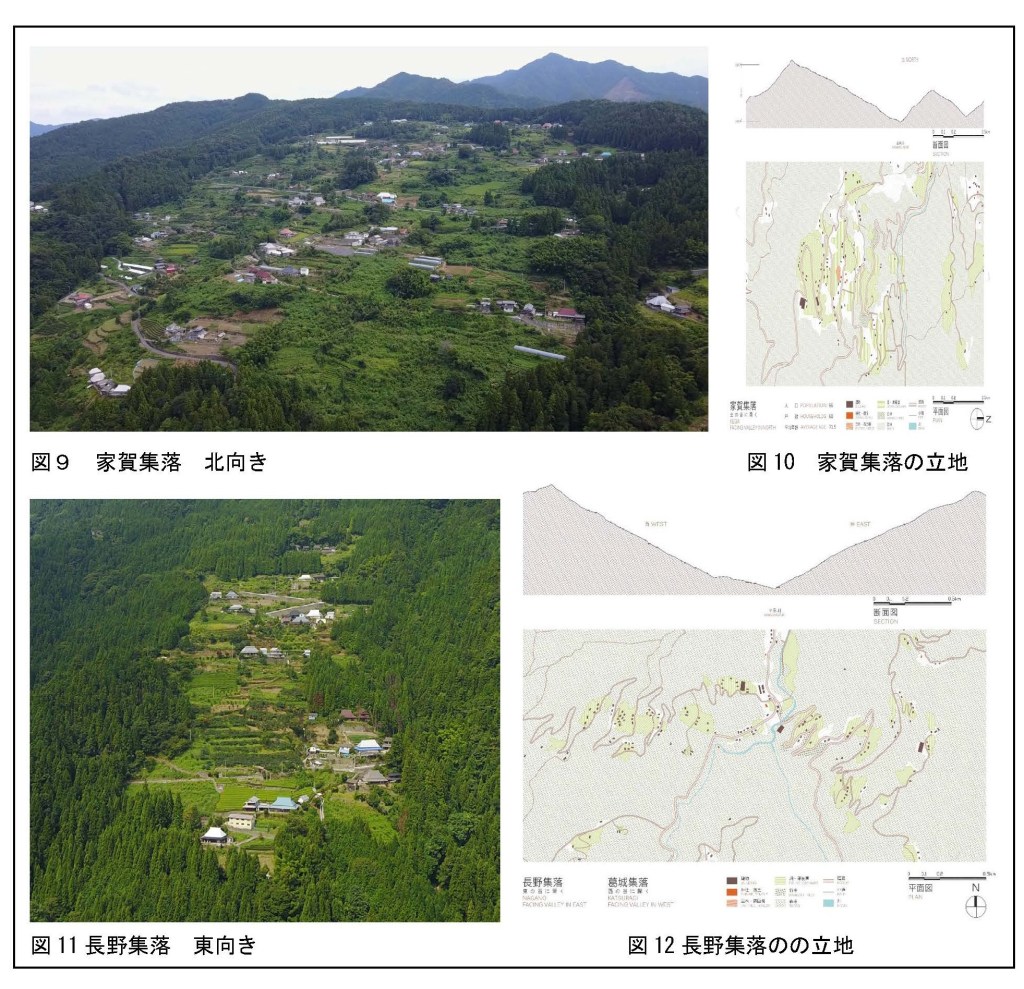
一般的に、日本の気候では南向きの建物が自然エネルギーの面では有利である。しかし,この剣では、集落は様々な方角を向いている。エネルギーに関する差異を考察するため、特に東西南北の4つの方角を明確に向いている4つの集落について調査した。これらの集落は、海抜約200mから740mの間に位置している。選定した4つの集落の平面図と断面図を図6~13に示す。いずれも、高齢化と人口減少が進んでいる集落である。
集落の向きに関わらず、すべての家屋は谷に面しており,集落は三方を水源保護林に囲まれ、見下ろす山々の神性によって守られた強固な領域を形成している。水源保護林は雨水と土壌中のバクテリアを保持し、土壌を肥沃にする。集落と神聖な山を結ぶ中心軸には、まるで子宮のように木々の茂みに包まれた村の神社が建っている。この神聖な中心核は、住民の生活の基盤である古来の種子やバクテリアを守っていて,自然環境との調和によって、その全体の形態は神秘的な力を帯びているように思われる。
調査結果を簡潔にまとめると、四方を向いた家々は真夏の日中の強い日差しを遮る効果がある。しかし、夏冬に受ける日射熱量は、山の斜面の向きと傾斜に大きく左右されている。傾斜は日射の強さと時間にも影響を与えている。
年間を通して見ると、南向きの家が最も多くの日射と熱を受ける。北向きの家は日射と熱が最も少ないが、東向きや西向きの家とそれほど大きな差はない。これは、北向きの斜面は緩やかで、農業を支えるのに十分な日照時間が長いためである。
多様な微気候への配慮 日照、土壌の質、気温、湿潤な空気の流れ、風といった様々な条件を考慮し、野菜、果物、花、豆類、ライ麦、トウモロコシ、ソバ、茶、鶏、養蜂など、多様な作物がそれぞれの微気候に合わせて選択的に栽培されている(図6、7、9、11)。収穫時期も、地域の自然環境に応じて自然にずれが生じている。
こうした自然環境の違いによって、地域内の競争が回避され、より強い共同体意識が育まれている。各地域の固有の強みを活かした、多様化した作物の限定生産は、持続可能性を高める複数の強みを生み出し、現代の効率的で集中的な単作生産とは異なる姿勢をとっている。
住宅形態の伝統 ―風と光への応答
最良の土地は耕作に、残りの土地は居住に利用される。埋め立てによって平らにされた土地には、畑から採取した岩や石が擁壁として使われている。家は一般的に前庭を作るために奥に建てられ、谷に面している(図14)。裏側は山腹に寄り添うように建てられた建物は、下部の擁壁と上部の急勾配の屋根が一体となって、山々を吹き下ろす強風から前庭と内部を守り、穏やかな渦風だけを運び入れる(図15)。内部と前庭の間にある深い軒と伝統的な縁側は、農作業や交流のための安定した環境を作り出す。常に谷を見渡す壮大な眺望を誇るこの空間は、住人を自然と心地よく結びつけると同時に、その中心から生活環境全体をコントロールしている(図14)。
奥まった内部空間は日光が遮断されている(図16)。この暗い中心部は、食料の保存、貯蔵、休息、繁殖といった重要な機能のために利用される。この地域特有の住居の構成と
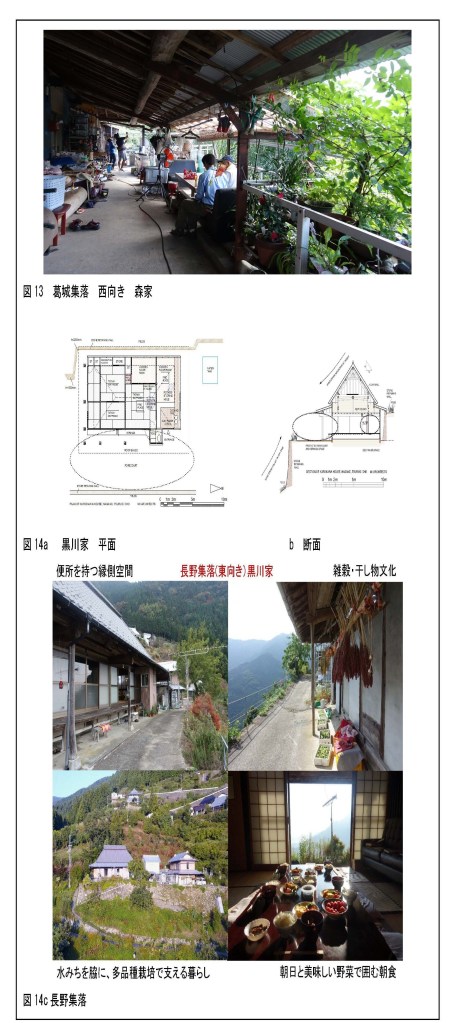
して、トイレは正面に位置していることがある。人糞を畑に運び、栄養源として利用するのである(図14)。高い屋根裏のロフトは、蚕の飼育に使われていた。北側にある貯水槽では魚が養殖されている。
一般的な家屋の形態は共通しているものの、方位によって地域差が見られた。西向きの集落である葛城では、非常に発達した広々とした日陰のある縁側空間が特徴である(図13)。赤松と長野で訪れた南向きと東向きの家屋からは、谷を見渡す素晴らしい眺望が広がり(図6、7、8、9、10、11)、赤松からは剣山を望むことができる。北向きの緩やかな斜面に位置するケカ(家賀)は、最も人口が多い集落である(図9)。北向きの家屋では、正面の北向きの軒の空間が非常に浅く、南向きの背面は比較的広く奥行きがあり、斜面の麓に沿って天然の湧水が流れている。
「地域性」の本質―住民との対話(図18)
1. 赤松市(南向き)の渡川さん:「昼夜の気温差、標高、方位、風向きといった自然の
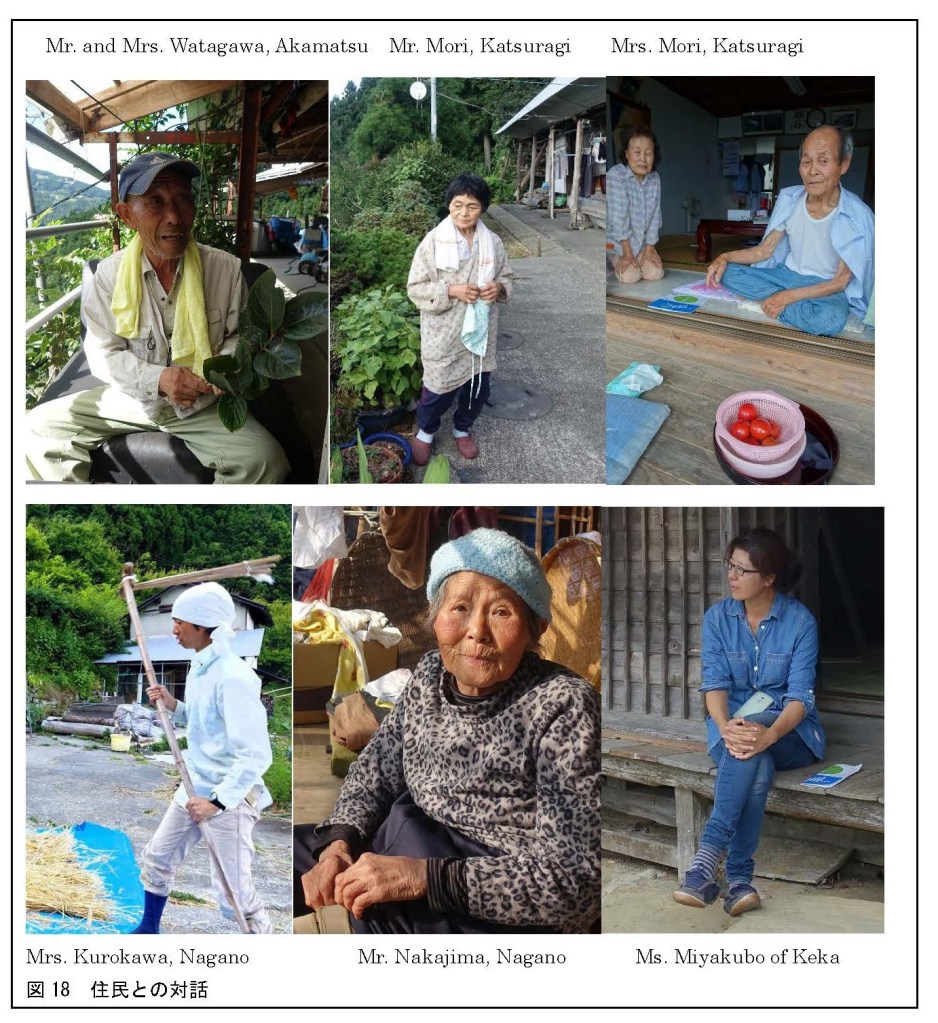
要素をよく観察し、活用することで、多様な作物を丈夫に育てられる環境が生まれます。」地形を深く理解することが、自然との実りある関係の始まりです。
2. 葛城市(西向き)の森さん:「山と調和して暮らしています。赤松(南向き)の柿は日照時間が長いので甘いんです。だから柿の葉でお茶を淹れるんですよ(日照時間が短い方が美味しいですからね)。」西向きの正面に広々とした日陰の縁側がある森さんの家は、様々な活動ができるように設計されています。(図13)それぞれの環境に合わせて作物を工夫して栽培することで、内部競争も避けられます。
3. 長野県の黒川さん(東向き):道路が通行止めになるほどの大雪について、「外部からの食料供給がなくても1ヶ月は生き延びられます」。多様な作物生産と食料貯蔵システムによる自給自足は、地域社会における高いレベルの持続可能性と連帯感を生み出し、災害に対する社会的なレジリエンスを構築していることがうかがえます。
4. 家賀集落の宮久保さん(北向き):村の神社は、村と聖山を結ぶ中心軸の中心に位置しています。住民は、集落の構造と周囲の地形との関係性において、自分たちの位置づけを自覚しています。
剣地域で伝統的な斜面耕作を選んだ科学者で地元住民の中島氏は、「争いや対立よりも、地域の利益を優先する自律的な選択ができます。周囲のコミュニティとの協力も相まって、日々の生活の中で自尊心と充実感を得ています」という。日常生活の中で、自分が循環する生態系における相互に関連する生命体のネットワークの一部であることを認識すると、人生に価値、意義、そして幸福感がもたらされるということである。
自然との深い相互関係
人口減少と高齢化にもかかわらず、その土地の潜在力は今日でもなお認識できる。集落の強い地域特性は、尊重され発展してきた相互関係の繊細なバランスを容易に認識することを可能にするのである。
その土地の潜在力を的確に観察することは、持続可能な生活環境を構築するための基本要素である。土地の潜在力は、地域文化とアイデンティティを形成する様々な手段や生活様式を生み出してきたけれど,今日では、若い世代はICTを使い、航空ネットワークを利用して、未来への新たな道を切り開こうとしていると思う。低エネルギー生活様式は、建物内部の環境に焦点を当てるのではなく、建物と人々が置かれている環境全体を観察、分析、そして対応することによって発展するのである。鋭い観察と理解を通して,自然を感謝して受け入れるための方法を見出すことができる。その試みが知恵と伝統として蓄積され、地域ごとの違いを生み出し、それが回復力を高めると同時に、アイデンティティと誇りをもたらしていく。
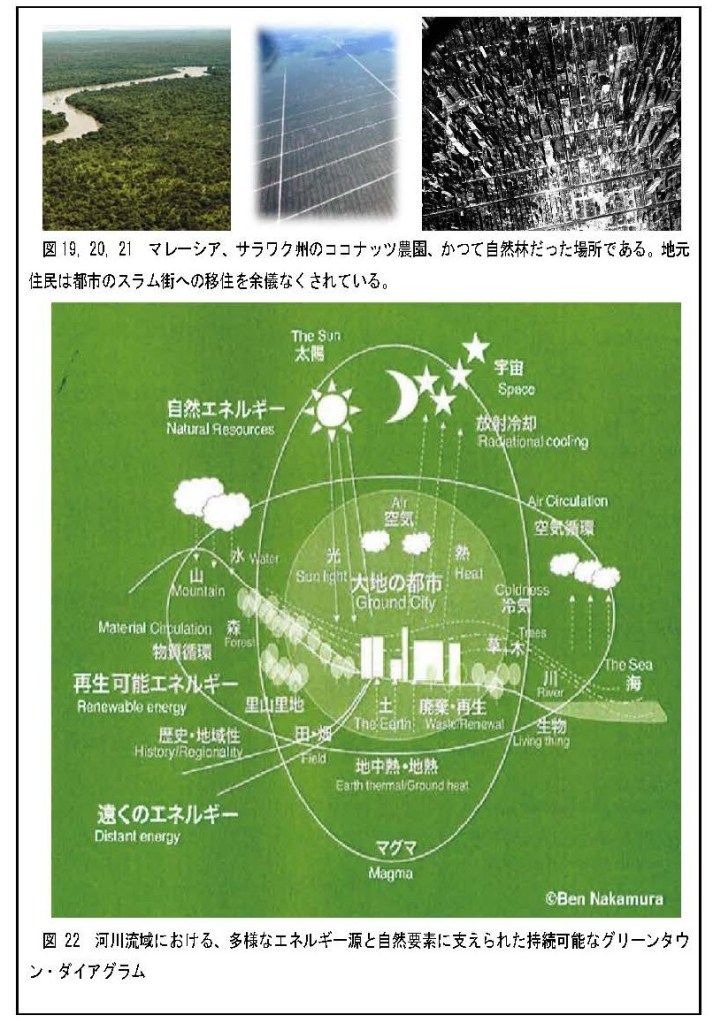
地球上グリーンシティのビジョン(図22)
グローバル化する経済が地域住民の自治を奪っているという懸念が高まっている。岩崎氏は、天然林が外部の利益のためにプランテーションに転換される一方で(図19、20)、依存的な国際都市は持続不可能で不安定な根無し草のような存在を隠し、孤立と孤独を生み出していると指摘している(図21)。
図22で説明されているように、中村氏は、グリーン化へのニーズが、自然再生可能エネルギーシステム、スローフードとライフスタイル、無駄な廃棄ではなくリサイクル、交通機関、宿泊施設、仕事の共有、よりゆっくりとした豊かな生活様式へと徐々に移行していくと予測している。個人から地球環境へと焦点を移すことで、パッシブエネルギー設計、複合用途地域、多世代コミュニティ、循環的な関係に支えられた生物多様性のある低炭素社会といった、持続可能性を基盤とした価値観の変化がもたらされるはずである。
現在の試行
伝統的な建築システムの可能性
地元の木材を使った建築は自然の循環を促進する
建築活動は二酸化炭素を排出するが,成熟した木材を建築に使用すれば、建物の寿命の間、二酸化炭素を固定することができる。同時に若い木を植えれば、木が成熟するまで大量の二酸化炭素を吸収し、酸素を放出する。そして、建築活動を通して二酸化炭素を削減する循環がすぐに始まる。
天然木材は再生可能で低炭素の建築材料であり、温かく柔らかく、心地よい色と香りを持っている。空気中の余分な湿気を吸収し、乾燥した時期には水分を放出するため、一年を通して快適であり,露出した木造建築はメンテナンスが容易で、美しく経年変化し、家族構成の変化にも容易に対応できる。
しかし,大量の輸入木材の流入により、地元の森林は手入れされずに放置され、地元の市場では建築材料として採算が合わなくなっている。地元の森林の間伐が行われないと、日光不足のため下草が生育できず、根元の土壌浸食につながる。手入れの行き届いていない森林は、大規模な土砂崩れの主要因であり、人命と財産の損失につながる。
東北地方の漁師たちは、古くから森林を維持してきたのであるが,森林が河川や海洋における魚の栄養分の流れを増やし、漁獲量を向上させるためである。牡蠣漁師の畠山重篤氏の環境保護活動が象徴するように、その基本は「健全な山は健全な海を育む」という古い諺に集約されているのである。
近年、日本では地元の建築資材を用いることが主流になりつつある。これは、建物を地域の景観に調和させ、地域経済の自立に貢献することにもつがる。プレハブ工法の導入によって失われつつあった伝統的に培われてきた木造建築の技術と知識も、現代において再評価される。以下に、伝統的な素材と工法を意識的に用いた4つの現代的な試みを紹介したい。
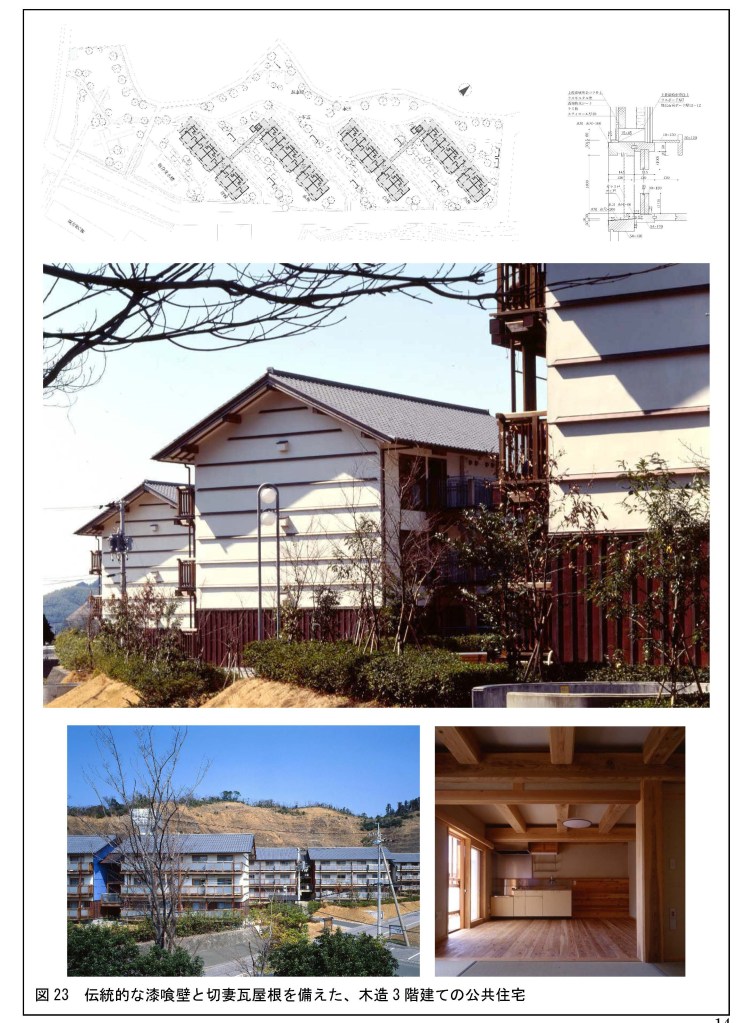
木造公営住宅―地域生活様式との融合(図23)
木材資源が豊富なことで知られる高知市は、高齢者向けの低所得者向け3階建て公営住宅を木造で建設し、模範的な事例を示している。建築家・山本久美氏は、この地域特有の豪雨や台風から建物を守るため、伝統的な瓦屋根の妻側に沿って水平に雨滴が落ちる構造と、漆喰塗りの壁という伝統的な組み合わせを採用している。
伝統的な木造建築を採用するにあたり、耐火性の大きな課題を克服するため、大径材が用いられています。150mm角の木製柱と300mm角および240mm角の木製梁は工場でプレカットされ、現場に搬入されて組み立てられる。厚さ45mmの木製床材は防音性に優れ、室内空間の快適性向上にも貢献する。各住戸に専用の玄関アルコーブを設け、4棟の建物を繋ぐ連絡橋を設けることで、人間的なスケール感とプライバシーの段階的な変化に富んだ居住空間が生まれ、自己表現と交流の両方を促している。
粘土の耐火性による経年変化の美しさ―密集した都市部における生活様式の歴史的連続性(図24)
戦前の住宅の多くが火災で焼失したため、戦後の日本の都市開発では、セメントモルタルと耐火外装材を用いた狭苦しい耐火建築が急増したが、それらは時とともに老朽化し、荒廃した街並みへと変貌してきている。しかし、粘土壁や無垢材は燃えにくい性質を持っている。東京の都市部でさえ、準防火地区では、竹の骨組みに規定の厚さの伝統的な粘土壁漆喰を塗った壁であれば、露出漆喰や木張りの壁が認められている。
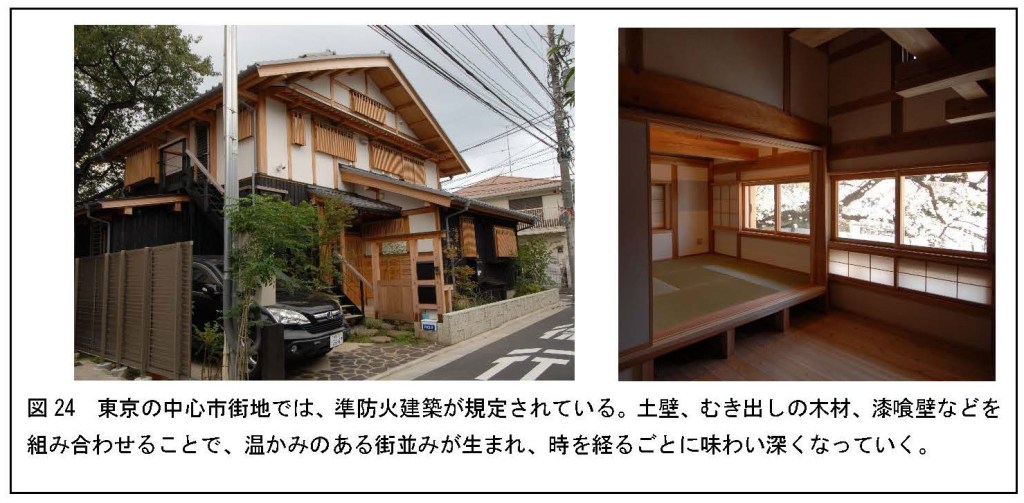
建築家・高橋正美氏は、東京の都市部において、生活環境における木、粘土、紙といった伝統的な素材との密接な関係を現代に継承するために、意識的に粘土壁を採用している。こうした自然素材が持つ深みと静寂は、時の流れとともに美しく変化していくこの街並みを、行き交う人々と分かち合う。
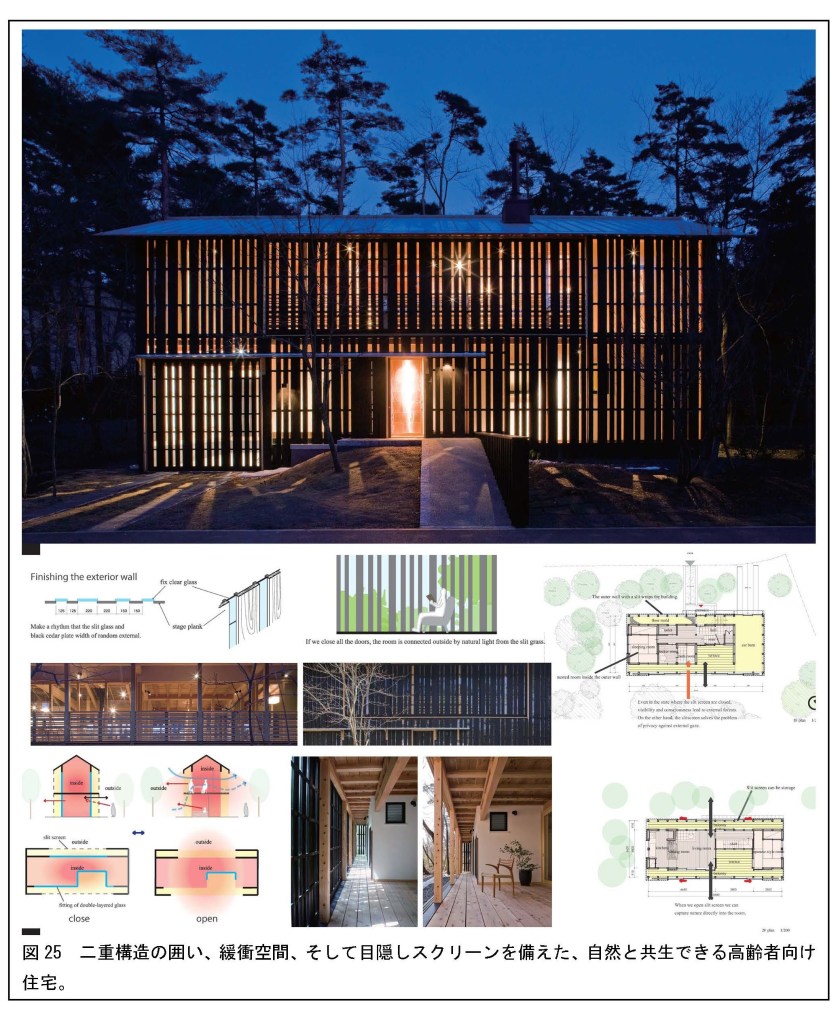
外装と中間緩衝空間のデザイン―自然との共生(図25)
西日本は、夏は高温多湿、冬は寒冷乾燥と、その度合いは地域によって異なる。このような気候の変化に対応する伝統的な省エネ設計は、頑丈で独立した柱梁構造の大きな屋根の下に、軽量で柔軟な間仕切りを組み合わせ、空間を遮ったり仕切ったりする。
大隅雄三氏が設計したこの老人ホームは、ガラスのスリットと黒杉の格子で覆われた囲いのあるベランダ空間を備え、周囲の森の木々に溶け込んでいる。扉や杉の格子を開閉することで、居住空間は周囲の環境と一体化したり、気候や季節に応じて快適な環境へと変化したりすることができ、一年を通してゆっくりと移り変わる風景を眺めながら、「家の中の家」のような空間を楽しむことができる。
循環的な関係性の再生―地球との再生(図26)
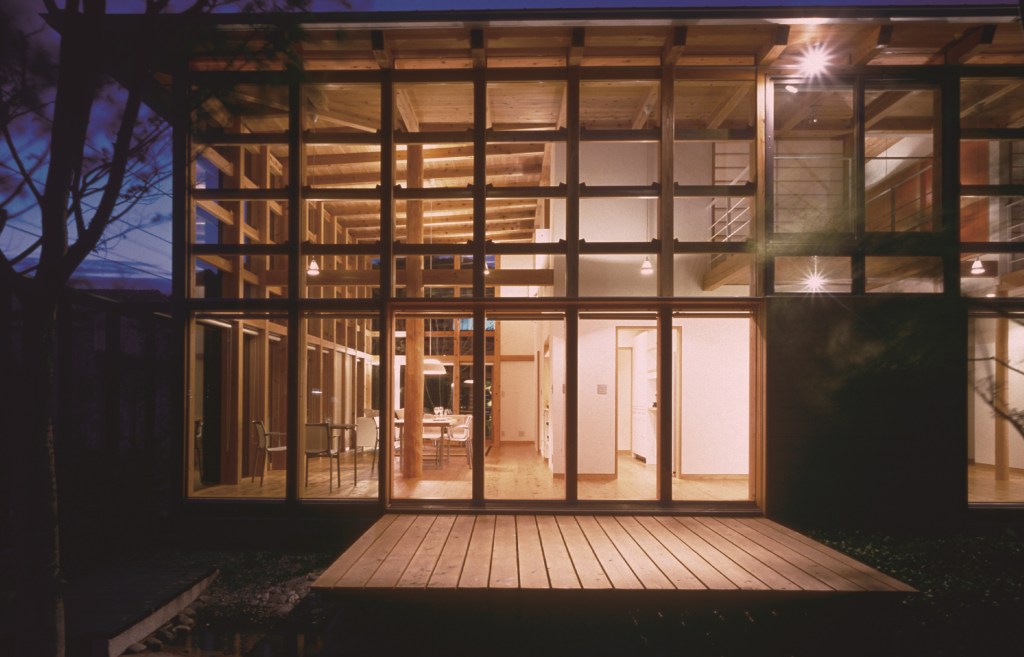
リノヴェーション後20年のこの家は、経済的にも環境に優しく、時を経てもその場所の記憶を留めることのできる解決策である。自然乾燥させた地元の木材を使用することで、木材本来の保護特性が保たれ、人体にも有益な効果をもたらしている。外壁を覆うフィン状の
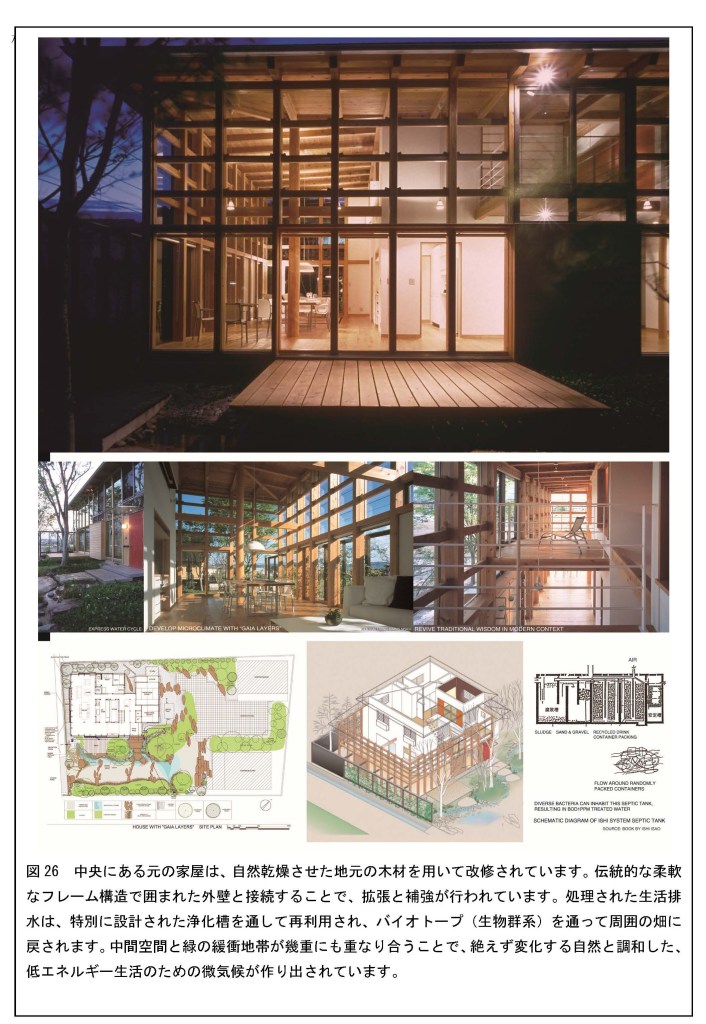
柱は、まるで籠のように桟木で編み込まれており、耐震性に優れた伝統的な構造システムが現代的な文脈で表現されている。
家から出るすべての排水は、自然環境に近い条件下で生息する様々な種類のバクテリアを含む特別設計の浄化槽で処理されている。その結果、BODが1~3ppm、CODが低い水が得られる。この水は雨水とともに庭を循環し、生物群集を育み、周囲の畑へと戻る。これは、日常生活における水の循環を視覚的にも触覚的にも表現している。
この生物群集は、高い木々のパーゴラの下を流れ、西側に沿って花を咲かせるつる植物の緑の壁やその他のスクリーンによって、室内空間の快適性を調整する微気候を作り出している。この庭園は、室内空間から外の世界、そしてその先の空や山々へと意識を広げ、周囲の景色を「借景する」という伝統的な庭園設計の手法を取り入れている。室内と屋外の間に緩衝空間を設けることで、絶えず変化する自然と一体となることで、エネルギー消費を抑えつつ、日々の生活に活力と喜びをもたらすライフスタイルを実現している。
この広大な循環空間での生活は、人と自然の循環的な関係性に対する新たな感性と意識を高めます。そして、時を経て、地域への帰属意識と責任感が育まれることを期待している。
Pursue Local Potentialities
Highland settlements of Tsurugi Mountain range in the Yoshino River basin
Terukazu Nii and Vasanti Menon Nii
Towards rebuilding a rich relationship between Man & Nature
With the strong need to change over to a green, low carbon society at a global scale, by 2020 all new buildings in Japan will mandatorily be covered by low energy by-laws. While improving environmental performance of each building, in this context how the local living environment and life style, based on the local traditional wisdom and skill of each locality, will be carried forward into the future in various parts of the country is a matter of concern.
For the realization of a stable and sustainable low carbon society, a holistic environmental design based directly on the local climate and cyclic ecosystems that link the mountain, river and ocean in every region would become an extremely crucial issue. The foundation for a self-sustaining, cyclic society would be green lifestyle based on a healthy and enriching relationship with the surrounding natural environment, supported by perceptive technology that enhances rather than controls or exploits natural systems. This would also lead to better disaster preparedness and social resilience.
Living with Floods along Yoshino River
Yoshino River, regarded one of the three greatest rivers of Japan, flows through Shikoku Island, one of the four main islands of Japan. 194 km long, it has a watershed of 3750sqkm and a history of flooding. (Fig 1) It carries nourishment from the mountains to the ocean via rivers, a large cyclic system linking forests and fields, nutrients and fish in the river and the ocean. (Fig 2)
From olden times local indigo fields relied on nutrition brought by regular floods of the river. Cultivating, living and working along the river, indigo farmers produced dye in enclosed compounds with high stone plinths. Tanaka house (Fig 3) has a row boat at hand. (Fig 3a) The central residential structure with straw roof is also designed to be cut loose from the roof frame to act as a float for residents to escape during floods. (Fig 3b, c) The dye was finally transported by river and land to all over Japan.
Unbroken global matter circulation
Rivers are part of complex, natural cyclic systems with various roles. Traditional flood protection systems of Yoshino River do not affect the natural substance circulation mechanism of the river.
- Bamboo forests along river banks (Fig 4-1) break down the force of flood water but allow nutrients through the flexible screen they create. Bamboo forests along Yoshino River are presently the largest existing example in Japan.
- A flood retarding basin (Fig 4-1), created by widening the river basin between its levees, reduces the volume of water flowing down stream at a time. It is used as agricultural land for growing a variety of vegetables in normal times. Supporting a wide variety of flora and fauna, it is a bio system that improves output of fishery.
- Stone groins are built at regular intervals perpendicular to the river banks (Fig 4-2) to interrupt water flow and to prevent bank erosion and sedimentation.
Upstream of Yoshino River, noteworthy complex natural systems have been ingeniously utilized in the built environment which are elaborated below.
“Native home in the Sky”, Sora
— Settlements on slopes with natural diversity
Mt. Tsurugi (”tsurugi” meaning “sword”) is one of the highest mountains in west Japan at 1955m above sea level. It is historically a religious symbol surrounded by many myths. In west Tokushima, along steep slopes of the Tsurugi mountain range that drain into Yoshino River via its tributaries, lie about 200 settlements, from 100m to 900m above sea level. They are located south of the Median Tectonic Line fault that runs through three of four Japan’s main islands. (Fig 1, 2)
The settlements are located on sites of landslides, resourcefully utilizing natural waterways which were exposed by the disaster at various altitudes, providing running water all through the year. Each settlement spans an altitude difference of a few hundred meters.
With good surface drainage, the slopes facing north are gradual, while those facing south are steep with hard rocky strata. Slopes facing the south are called’ hinoji’, “land in sun” and slopes facing the north, ‘kageji, “land in shade”. In this latitude, facing south is considered advantageous for obtaining warmth from the low winter sun. But here, without hierarchy, the potential character of each area is taken advantage of.
The deep valleys funnel in strong horizontal winds (Fig5-1). Strong vertical winds blow up the valley in the day and down the mountain at night. (Fig 5-1) This wind flow, coupled with altitude difference that offers differing temperature and soil strata, results in a wide variation of micro-climates which offer a wide variety of animal and plant life. The sharp change in daily temperatures also increases quality and durability of farm produce. The higher altitudes have older houses with more advantage of comparatively flatter land and more exposure to sunlight.
Distinguishable common features of these settlements (Fig 5-2)
- ”Odo” are timber structures characteristically open on three sides. They are pavilions for prayer that support the community. They are located along main movement routes. Besides community prayer meetings here, eye contact across the valley between the residents is also an unexpectedly strong binding factor.
- ”Hade” are timber frameworks for drying farm produce. They are fixed over retaining walls of dry stone masonry which store heat from the sun in the day and release infrared radiation at night. This accelerates drying from exposure to sun and wind, and supports a well-developed food preservation culture, strengthening self-sustainability of the settlements. Presently in bad repair, if stone wall maintenance is made part of public works, it would keep alive traditional skill, utilize natural resources and avoid use of cement. (Fig 17)
- ”Koeguro” are haystacks of locally grown “kaya” grass stored along the slope. Exposure to sun, rain and winds breeds bacteria in the hay which is then laid along the contours of the sloping fields for replenishing the soil. This system has preserved the local ecological cycle for generations. Moreover, seeds of species handed down over generations have been collected, preserved and reused, completing a local sustainable eco cycle preserved over a long period of time.
The kaya grass is highly insulating as roofing. Though outdoors its surface temperature is higher than tile, indoors its surface temperature is lower than tile. (Fig 5-3)
- Characteristic slope land fields (not terraced) are cultivated along natural contours. Sloping land receives more energy from the Sun than flat land. They also rise closer up to the farmer. But this system requires more labor to keep the soil in place, sometimes rising up to 30°.Laying of fermented hay along the land contours has prevented landslides along these steep slopes.
This unique sustainable agricultural system of “slope land farming” was recognized in 2018 as a World Agricultural Heritage Site.
Settlement form relating to divinity
Generally, south facing buildings have natural energy advantage in Japan’s climate. In this region, settlements face various directions. Four settlements, each clearly facing four cardinal directions, were specifically selected for insight into energy related differences. They are located roughly between 200m to 740m above sea level. The plans and sections of the four chosen settlements are shown in Fig 6, 7, 8, 9, 10, 11, 12 & 13. All have populations that are aging and shrinking.
All houses face the valley, irrespective of settlement orientation. Watershed protection forests surround the settlements on three sides, creating a strong domain protected by divinity of the overlooking mountain. These forests retain rain water and bacteria in soil, also nourishing it. At the central axis linking the settlement to the divine mountain is the village shrine, enveloped by a thick grove of trees, like a womb. This sacred central core protects ancient (original) seeds and bacteria, the bases of livelihood of the residents. By relating to its natural environment, the overall form seems bestowed with mythical power.
Ar. Kawashima’s analysis in brief finds that houses facing all four orientations cut off the hot summer sun of midday. But the amount of heat inherent in sunlight received in summer and winter is greatly affected by orientation and angle of mountain slope. The latter also affects the intensity and length of time sunlight is received.
Over the whole year, a south facing house would receive the most amount of sunlight and heat. Houses facing north receive the least amount of sunlight and heat but not too different from those facing east and west. This is because the north facing slopes are gradual and receive sunlight for a longer period of time, enough for supporting farming.
Respecting different microclimates
Responding to the combined circumstances of sunlight, quality of soil strata, temperature, moist air flow and wind, various species of crops like vegetables, fruits, flowers, beans, rye, corn, buckwheat, tea, chicken and bee keeping are selectively cultivated in the varying microclimates. (Fig 6, 7, 9, 11). Harvesting periods also naturally stagger depending on the area’s natural circumstances.
This has avoided internal competition and builds better communal solidarity. Limited production of highly diversified crops based on inherent strength of each area has given plural strengths that increase sustainability, a stance different from modern efficient, centralized monoculture production.
Heritage of house form –response to wind and light
The best lands were used for cultivation and the leftover land for living. Rock and stone from the fields were used for retaining walls for houses, built on land flattened by infill. The house is generally set back to create a forecourt and faces the valley. (Fig 14) The back is closed and set against the mountain slope. The retaining wall below and the steep roof above act together to protect the forecourt and interior from the daily strong winds flowing up and down the mountains, bringing in only the soft eddy winds. (Fig 15)
The deep eaves and traditional verandah (’engawa’) between the interior and forecourt create a stable environment for farm work and social exchange. Commanding a magnificent view across the valley it always faces, this intermediary space connects the residents in a most comfortable way with nature while controlling the total living environment from its center. (Fig 14)
The deep interior is cut off from daylight (Fig 16). This dark core is used for important functions of food preservation, storage, rest and procreation. Unique to this region, the toilet is located in the front, convenient for carrying human waste for nutrition to the fields (Fig 14). The loft under the tall roof was used for breeding silkworms. A water tank in the north breeds fish, used as an indicator for foreseeing natural disasters.
Though consistent with the general house from, local differences were observed depending on the orientation. The chosen west facing house of Katsuragi has a very well developed, spacious, shaded veranda space. (Fig 13,13a,13b) The south and east facing houses visited in Akamatsu and Nagano have fantastic, open views across the valley (Fig 6, 7, 8, 9, 10, 11), the former with a view of Mt. Tsurugi. Keka, with a gradual slope facing north, has the largest population. (Fig 9, 10a) The chosen north facing house has a very shallow eaves space in the front, facing north. The back that faces south is comparatively wide and deep, with a natural water spring running along the foot of the slope. (Fig 10b)
Essence of “local potentiality”
–conversation with residents (Fig 18)
- Mr. Watagawa of Akamatsu, facing south: “Good observation and utilization of natural difference in day and night temperature, altitude, orientation and wind flow offers a variety of environments appropriate for a wide range of durable, high quality crops.” Knowing the landscape thoroughly is the beginning of a fruitful relationship with nature.
- Mr. Mori of Katsuragi, facing west: “Live in harmony with the mountain. Persimmon fruit of Akamatsu (south facing) is sweet (because of the long hours of sunlight it receives). That is why I make tea from the persimmon leaves (better off with less sunlight).” His house, with a spacious shaded verandah along the front facing west, is planned for plenty of activities. (Fig 13, 13a,13b) Growing well considered produce to suit given circumstances, also avoids internal competition.
- Mrs. Kurokawa of Nagano, facing east: Regarding a heavy snowfall that blocked approaching roads,”I can survive for a month without any external food supply.” It may be observed that self-sufficiency from a variety of crop production and food storage systems creates a high level of sustainability and solidarity in community relationships, building social resilience in the face of disaster.
- Ms.Miyakubo of Keka, facing north: “The village shrine is located at the center of the central axis linking the village and the sacred mountain.” Residents are aware of their own position with respect to the structure of the settlement and its relationship with the surrounding topography.
Mr.Nakajima, scientist and local resident, who chose to do traditional slope farming in Tsurugi region concluded: “Autonomous choices, which give priority to local benefits, are made over struggle and conflict. Along with cooperation from the community around him, this offers self -respect and fulfillment in everyday life.” Knowing from daily life that one is part of a network of interrelated living beings in a cyclic ecosystem offers value, meaning and wellbeing in life.
Deep interrelationships with nature
In spite of the reducing and aging population, begun from the 1960s, potentiality of the place can still be identified today. The strong geographical features of the settlements make it easy to recognize the fine balance of interrelationships that have been respected and developed.
Well observed potentiality of a place is a basic factor for building a sustainable living environment. It gives rise to various devices and ways of life that build the local culture and identity. Today, the younger generation is trying to use ICT and proximity of the settlements by air to cosmopolitan areas to pave a new way for its survival into the future.
A low energy life style evolves by focusing not on the environment inside the building, but by observing, analyzing and responding to the total environment in which the building and people are located.
Intermediary buffer spaces are very important environmental devices that link Man with Nature. They are used to adapt and change contradictory natural circumstances through keen observation and understanding and to receive with gratitude the positive natural circumstances. This has accumulated as wisdom and tradition, creating regional differences that build resilience while offering identity and pride.
Vision of green city on the Earth (Fig 22)
There is rising concern that our globalizing economy is robbing local people of their autonomy. Ar. Iwasaki observes that while natural forests are being converted into plantations for the benefit of external beneficiaries (Fig 19, 20), dependent cosmopolitan cities hide their own unsustainable, insecure rootless existence, breeding isolation and loneliness. (Fig 21)
As explained in fig 22, Ar. Nakamura foresees that our need to become green would slowly see a shift to natural renewable energy systems, slow food and lifestyles, recycling rather than wasteful disposal, sharing transport, accommodation and work, a slower and richer way of living. Focus from the individual to the global environment would see a change of values leading to sustainability based on passive energy design, mixed zoning, mixed age group communities, a low carbon society with biodiversity supported by cyclic relationships.
Notes:
Article based on
- Introduction to Tsurugi cho area by
Hiroaki Hayashi and agronomist Yasuyuki Noda,
Tsurugi Town Hall administrative staff, residents, Yasunori Nakajima & Takashi Sakae, organic farmer, Akifumi Bando and student, Soma Nii, Tokyo Institute of Technology.
- Study survey conducted by
Nii Architects and Associates with JIA, Shikoku Chapter,
Ar. Dr. Norihisa Kawashima, Tokyo Institute of Technology,
Dr. Junko Sanada, Tokyo Institute of Technology
with cooperation from
Dr. Zhao Chong, Fuzhou University, China, local residents interviewed and
interns Yi Chi Liu & Han Ru Chang, Chung Yuan Christian University, Taiwan
Presented at
The Annual JIA Congress, Tokushima, 29th September, 2017
- Presentations at the JIA National Congress, Tokushima, on the theme: “The Architect and the Indigenous” between 29th~30th September, 2017.
Symposium on Environment held on 29th September, 2017
organized by Terukazu Nii
Cover presentations by
Architects: Ben Nakamura, Shunsuke Iwasaki, Terukazu Nii,
Architect & Environmental Analyst: Dr. Norihisa Kawashima,
Structural Engineer: Dr. Junko Sanada,
Scientist & resident of Tsurugi cho: Kazunori Nakajima
Excerpts of presentations edited by
Terukazu Nii, & Vasanti Menon Nii, Nii architects and Associates.
- Study of Citizens’ study group,
“Considering the future of Yoshino River and Daiju Barrage”
Visual material, besides mentioned otherwise, provided by
Nii Architects and Associates.
Contemporary attempts
Potential in traditional building systems
Building with local wood promotes natural cycles
Building activity produces carbon di oxide. If mature trees are used for building it would fix carbon for the life span of the building. Simultaneously planting young trees will absorb large amounts of carbon di oxide and release oxygen until their maturity. And this will immediately begin a cycle of reducing carbon through building activity.
Natural wood is a replenishable, low carbon building material, warm & soft, with soothing color and aroma. It absorbs extra humidity in the air and gives out moisture during dry weather, offering comfort throughout the year. Exposed wood construction is easy to maintain, ages elegantly, is easy to reform and adapt to changes in family cycle.
A big influx of imported wood has forced local forests to remain unmaintained, being unviable as building material in the local market. Without thinning of local forests, undergrowth cannot survive, due to lack of sunlight. This leads to erosion of soil at the roots. Unmaintained forests are a major cause of heavy landslides, resulting in loss of life and property.
Fishermen of Tohoku region traditionally maintained forests because this increases flow of nutrients for fish in the rivers and ocean and improves yield in fishery. Symbolized in the environmental work of oyster fisherman, Shigeatsu Hatakeyama, it is summed up in the traditional saying, “A healthy mountain, a healthy ocean”.
Using local building materials has recently become more mainstream in Japan. It helps blend the building with the local landscape and contributes to local economic autonomy. Traditionally developed skill and knowledge of timber construction, disappearing with the influx of prefabricated industrial material, is also being reconsidered in the modern context. Four contemporary attempts consciously using traditional materials and building methods are introduced below.
Public housing in timber
–Association with local lifestyle (fig 23)
Kochi, known for its abundant resource of timber, has set a blazing example by building public (low income) three storied housing (for the aged) in timber. Architect Hisami Yamamoto uses the traditional combination of lime plastered walls with regular horizontal rain drip along the exposed gable side of the traditional tiled roof as protection from the heavy rains and typhoons of the region.
Traditional exposed timber construction being adopted, large sections are used to overcome the major problem of fire resistance. 150mm square timber columns with 300mm & 240mm square timber beams were precut in the factory and delivered on site for assembly. 45mm. thick wooden flooring is suitable for sound proofing requirements and also contributes to better comfort of interior spaces. Private entrance alcoves for each residence and interconnecting bridges linking the four blocks creates residential spaces with good human scale and privacy gradation that encourages self-expression as well as interaction.
Fire resistance of clay for beauty of aging
–Historical continuity of lifestyle in dense urban district (fig 24)
Much of pre-war housing stock lost in fires, the post war urban development in Japan saw a burst of cramped fire-resistant building in cement mortar and fireproof siding material which deteriorated into dilapidated neighborhoods with the passing of time. Actually, clay walls and solid wood members are difficult to burn. Quasi-fire prevention districts even in urban areas of Tokyo allow exposed plaster and wood clad walls if they are made of a stipulated thickness of traditional clay wall plaster on bamboo framework.
Architect Masami Takahashi consciously uses it in urban Tokyo for continuing into the present, the traditional close association with wood, clay and paper in the living environment. The depth and tranquility of such natural materials are shared with passersby as the district mellows beautifully with the passing of time.
Design of skin and intermediary buffer spaces
–Living with nature (fig 25)
West Japan is hot and humid in summer, cold and dry in winter in varying degrees. The traditional low energy solution to cope with such a variation of climate is a variety of light, flexible partitions, used in combination for sheltering or dividing spaces under a large roof built from a very sturdy and independent column and beam framework.
This retirement house designed by Yuzo Ohsumi, has an enclosing veranda space, the entire surface of which is made of glass slits and black cedar slat screens blending into the surrounding trees of the forest. By closing or opening the doors and cedar screens, the living space can become one with the surrounding or adjust into a comfortable environment depending on the climate and season, for enjoying the view of the landscape slowly changing over the year, a ‘house within a house’.
Reviving cyclic relationships
–Renovation with the Earth (fig 26)
Renovating a twenty-year-old house was an economically viable, green solution that would retain memories of the place over time. Naturally dried local timber is used as it retains the inherent protective properties of the timber, also beneficial for humans. Through battens weave the enclosing fin-columns like a basket, a seismically resilient traditional structural system expressed here in a modern context.
All sewage water from the house is treated in a specially designed septic tank with various kinds of bacteria that live in conditions similar to a natural environment. This results in water treated to 1~3 ppm BOD and low COD. This is circulated along with rain water in the garden, nurtures a biotope and returns to the surrounding fields, visually and tangibly expressing the water cycle in everyday life.
This biotope, flowing under a pergola of tall trees, a green wall of flowering creepers along the west and other screens create a microclimate controlling comfort of the interior spaces. The garden extends awareness from the interior spaces onto the outside, the sky and mountains beyond, such traditional garden design said to “borrow scenery” from the surroundings. A combination of buffer spaces between the inside and outside allows for a low energy lifestyle with rejuvenation and joy in everyday life from being one with continuously changing nature.
Life in this vast cyclic space has cultivate a new sensitivity and increased awareness of the cyclic relationship between man and nature. Over time, a sense of belonging would hopefully develop, along with a sense of responsibility towards the region.
Notes: All visual and written material provided by respective architects, translated by Terukazu Nii and Vasanti Menon Nii, Nii architects and Associates.

コメントを残す